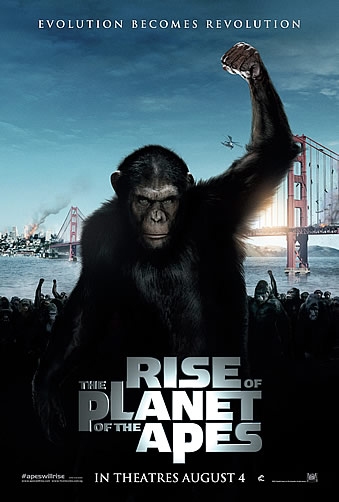
Seldom has a movie achieved to be both invigorating and, at the same time, conscious of its own role within a common social topic. Planet of the Apes achieves this degree of elegance while sustaining in the only possible and believable way, a concept that on its own would never work without a solid story like the one this flick displayed.
Now, it is important to recognize that this is not a movie for self-discovery, catharsis or even to get a deeper insight on human kind. No, Rise of the Planet of the Apes is primarily, a relaunch of a cult science fiction saga based on the concept of a planet ruled by apes, a movie where you'll get to see superbly intelligent apes (no, not monkeys) beat the crap out of human kind after they have been given a superior cognitive function because of an Alzheimer medication trial. Leaving aside all the intellectual mumbo-jumbo one can come up with to make everyone who watches this movie feel uncultivated in the field of artistic filmmaking, it was an enjoyable flick. A guilty pleasure, if you wish.
Starting from the concept that the writers tried to develop: A film about a man who, in an attempt to desperately help his dad overcome Alzheimer's disease creates an experimental drug named ALZ-112 which, while tested on apes, revealed to improve and enhance cognitive function. Factor that leads to the birth of a superior being: an intelligent ape (capable of creative reasoning, self-recognition and complex and abstract thinking). An ape named Caesar, who will eventually lead the rebellion of apes against humankind, in a clear and blatant analogy to some rebellions that have rose throughout human history from oppressed societies.
Planet of the apes is primarily created in CGI and that's fully understandable, given that the images shown in the movie would make any Animal Welfare organization to shut down every single stage of, and what a nice display of Technological talent and mesmerizing art design it showed. The film captures subtle but nice panoramic shots that capture one's sight and makes for some very memorable moments and make CGI-created apes feel like real creatures one can identify with and even, if I dare to say, as tangible as humans. Special mention to the scenes or Caesar's growth, where the film flashforwards 5 years into the future after Caesar turns 3 years old. The film also enyoyed some very poetic and symbolic moments that emulate if not succeed over its 1970's predecessor (and makes Tim Burton's 2001 remake look like a joke).
In the acting department, James Franco delivers a slightly-above-average performance that improves his image as an actor but leaves the audience and mourning over Tobey Maguire's decision not to star in the movie. On the other hand, Andy Serkis' performance as Caesar makes the movie be worth the 66 pesos it costs: his performance as a lovely ape that slowly progresses into a leader of the 'Ape Army' shows a nice transition from light to dark, that makes Caesar a broken anti-hero for the Apes as a true and merciful leader.
On what Rise of the Planet of the Apes represents, in terms of the complex philosophical conundrum it tries to explore, an extreme fight that is extrapolated from what can be simply described as "the oppressed versus the dominant". It also explores some frights that humans have over other species acquire intellicence comparable or even superior to that of human beings. Why are humans so afraid of finding an intellectual match? Why are we afraid of not being the superior race? The problem with Apes is that is sense of purpose seems somewhat distorted. Is it an action movie that reflects on the repercussions of irresponsible science? Is it a movie about how nature will arise and fight against humankind as a punishment for their ill-considered actions against nature and the environment? Is it a movie that reflects on how societies should rise with a common leader against oppressors?
The movie, as simple as it might seem, has the potential of creating and postulating some very controversial and, maybe, unanswerable questions. As for the closing scenes that have the potential of creating a whole new saga, my answer is: Bring it on, if this level of quality is maintained.
Overall grade: B- (3 stars)
Rotten Tomatoes: 83%
Metacritic: 68
On a "don't see it" to "must see" scale: WOULDN'T HURT TO WATCH IT

 Unlike cats, this blog actually has had 9 lives -or more (except for Schrödinger's, that cat is seriously screwed). Today is one of those times when I get to promise myself (and my deluded readers) that I'll update this blog more often or that I will manage to make it a viable option for fringe-culture fans out there to find a place to discuss the ironies that this world has to offer. Indeed, I make this promise again, for the "N"th time. Yet, I seriously hope I can maintain this promise and bring life back to this lonely bin of words. Just like movie franchises nowadays I'm rebooting this wasteland in hopes for a better tomorrow (or a better use of my spare time). In my mind, this newly-found post-apocalyptic reality offers the chance of being cool and letting my crazy words be out in the world. Do expect interesting references and convoluted plotting, for this blog is alive once more. Without further ado...